
The Mohs Hardness Scale
The Mohs Hardness Scale
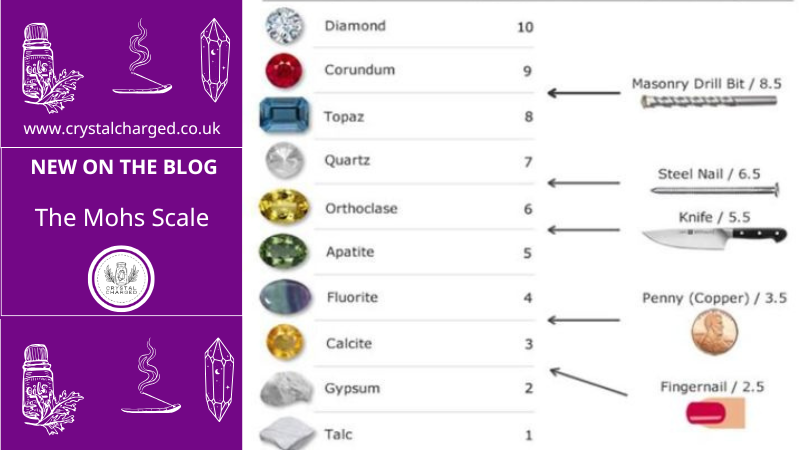
The Mohs hardness scale was created by German geologist & mineralogist Friedrich Mohs in 1812 to find out how hard a mineral is compared to another mineral.
The scale gives minerals a value between 1-10 on how much they scratch another mineral or how hard they can be scratched before it’s damaged.
It starts with the softest mineral, talc ranked as one to diamond ranked as ten.
Because Mohs used common minerals of varying hardness it was an easy way for geologists & mineral collectors to find out & see how scratch resistant a wide variety of minerals are.
The scale is divided up onto ten levels, with each mineral given a number based on it’s ability to scratch the one below it.
Each mineral is ranked based on its ability to scratch the one below.
A mineral ranked six can scratch any mineral ranked 5 or lower but can be scratched by minerals ranked seven or above.
The system gives a quick comparison of hardness between minerals & helps decide the identity of unknown minerals.
Geologists will often carry a set of test minerals, such as a steel file, a copper coin & a piece of quartz to test the hardness of a mineral.
The Mohs scale has been used by the geological community for over two hundred years, but it has its limits.
Finding out if one mineral can scratch another one depends on the accuracy of the test & can vary based on surface roughness or impurities in the minerals.
Despite this, the Mohs scale is still the go to method of basic mineral identification; because it’s easy to use, without the need to use more advanced equipment.
There are other methods for finding out the hardness of minerals, i.e. the Knoop & Vickers scales, but the Mohs scale’s reliability means it’s still the scale used the most by geologists.